If you run hotel engineering, you already live in the real world of pool operations: heavy bather loads, sunscreen oils, filtration limits, “why is it cloudy again?” weekends, and the constant push-pull between water quality, chemical cost, maintenance hours, and guest complaints.
Cavitation can sound like a lab concept, but it’s actually straightforward when you frame it the way engineers think: energy + flow + micro-scale physics that helps break down the stuff that makes water harder to keep clean.
Discover how cavitation improves water purity in plain language, what it affects in pool systems, and why it can reduce operational volatility for commercial pools and spas.
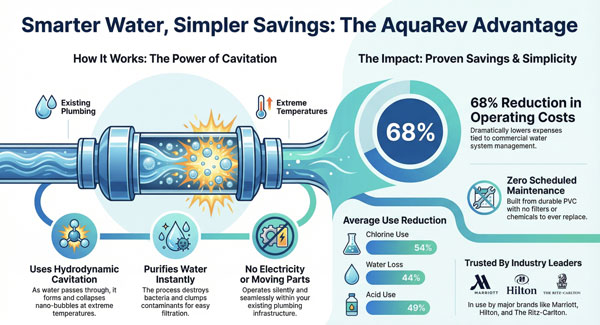
Cavitation is the rapid formation and collapse of tiny bubbles in water, creating localized energy that helps break apart contaminants and disrupt problem compounds.
Think of it like “micro-scrubbing” at the molecular level—happening inside a controlled device rather than with brushes, extra chemicals, or constant reactive dosing.
A pool can be “within spec” on sanitizer levels and still perform badly from an operations standpoint because the water contains a lot more than microbes:
Sanitizer is necessary, but it’s not always efficient at dealing with everything that creates odor, haze, and rework.
When cavitation bubbles collapse, they generate tiny, intense micro-events in the water. You can think of those events as doing three practical things:
Organics are the “food” and precursor material behind many quality issues (including odor and haze). Cavitation can help fragment and disrupt these compounds so they’re easier for the system to manage and remove.
In many water systems, better oxidation reduces the need to constantly “hit it harder” with chemicals to maintain clarity and comfort—especially after heavy use.
Some pool problems aren’t one-time events; they’re recurring because the system is always catching up. Cavitation can support more stable water conditions so you spend less time cycling between “fine → drifting → correction.”
Engineer translation: fewer “mystery haze” Mondays and fewer emergency interventions after peak occupancy.
Engineers don’t buy concepts. They buy fewer headaches. In commercial pool environments, cavitation is typically used to improve:
To keep expectations grounded:
In other words: it’s not “instead of” your program—it’s “make your program easier to run.”
Most installations are designed to integrate into the pool’s existing hydraulic loop so the device treats circulating water continuously.
That matters because the benefits come from:
Engineer lens: it’s another process step in the treatment train—one that targets what filtration and sanitizer alone don’t always handle efficiently.
Guests don’t care how you got there. They care about outcomes:
Those outcomes reduce front desk escalations and protect reviews—but they start in engineering.
AquaRev Water applies cavitation principles in a solution built for commercial pool and spa environments where operators need:
For Chief Engineers, the practical question is:
Will this reduce my weekly workload while improving consistency?
That’s exactly the operational gap cavitation is meant to address.
If you’re experiencing any of the following, cavitation-based treatment is typically worth a serious look:
If you have 2–3 of these consistently, you’re not dealing with a one-off issue—you’re dealing with a system that’s fighting itself.

Proud to be the leading solution for water purity, operating cost reduction, and water use responsibility.
Patent #:
10,934,180
11,358,881
12,037,269